Rex
Klara and the SunRex is a B2, third-series Artificial Friend whose short career in the store’s front alcove turns a private worry into a visible market risk. He jokes that Klara has taken too much of the Sun’s nourishment, but the joke carries a trace of genuine unease: when a customer asks about third-series solar absorption problems, Rex remains smiling as she rejects him. He eventually finds a home, yet his episode leaves the store’s claims of reliable specifications in tension with the bodily fears its AFs experience and the rapid arrival of newer models.
Identity and Introduction
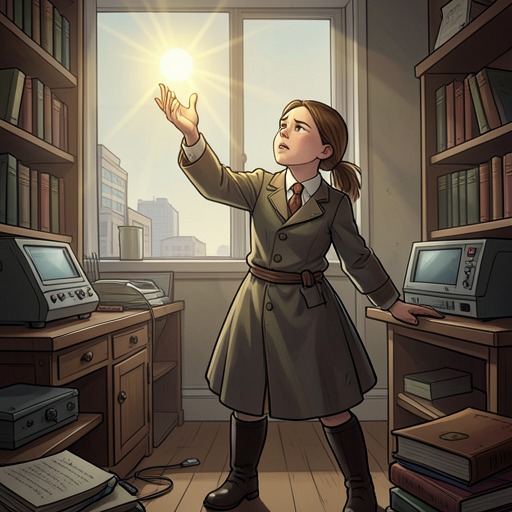
Rex is a boy AF and a B2 of the third series. When Klara and Rosa are new to the store, he stands alongside them and offers reassurance about the Sun’s reach. He points to a pattern of sunlight on the floorboards and tells them they can touch it to become strong again, presenting nourishment as something available even when an AF cannot see the Sun directly.
Klara tests this advice when the store is empty and the Manager is busy at the Red Shelves. As soon as Klara touches the pattern, it fades. She pats the spot and rubs the floorboards, but the light does not return. Rex calls her greedy and says that girl AFs are always greedy. Klara initially suspects that the Sun’s pattern has withdrawn by chance, while Rex maintains a serious expression and insists that she has taken all the nourishment for herself.
The Front Alcove and the Customer
The Manager moves Rex to the front alcove, a position that places him among the first AFs a customer entering the store will see. The Manager says every position is carefully chosen and offers equal chances of selection, but the AFs know that customers’ attention falls first on the alcove. Rex is pleased with the posting, and from mid-store Klara and Rosa watch him stand with his chin raised, covered by the Sun’s pattern. Rosa thinks he looks wonderful and predicts that he will soon find a home.
On Rex’s third day in the alcove, a girl enters with her mother. The girl goes straight to Rex and stares up at his face; when she runs a hand down his arm, he remains still and smiles, following the store’s instruction for a customer showing special interest. Her mother asks the Manager which model he is. The Manager identifies him as a third-series B2 and recommends him as a companion who could encourage a conscientious and studious attitude.
The mother then names the concern directly, asking whether third-series models are the ones with solar absorption problems. Rex is present as she asks. The Manager concedes that there were minor issues at the start of the series but says reports were greatly exaggerated and that ordinary light poses no problem. She adds that series-three models have brought happiness to many children and that only unusually dark environments, such as Alaska or a mineshaft, should be cause for worry. The mother nevertheless decides Rex is not right for her daughter, though she acknowledges why the girl likes him. The child looks baffled as the adults discuss the defect claim in front of him.
Nourishment, Defect, and Rejection
Rex continues smiling until the customers have left and shows no visible sadness afterward. For Klara, the encounter recalls his earlier accusation about the Sun’s nourishment. She now suspects his questions about how much nourishment an AF can receive had occupied his thoughts for some time. His joke therefore registers not simply as teasing but as a hint of anxiety that the store’s public confidence cannot erase.
The episode sets the Manager’s official assurances against the AFs’ private experience. Their specifications supposedly guarantee that room position and similar factors cannot affect them. Yet an AF away from the Sun for a few hours may feel lethargic and fear that something is wrong with him—that he has a fault unique to him and, if it becomes known, will never find a home. The window matters not only as a place of display and a chance to be chosen, but as the place where the AFs hope to receive the Sun’s nourishment. Rex’s rejection makes those linked hopes concrete: the customer’s concern about a technical weakness is also a judgment about whether he can be trusted as a companion.
Sale and the Changing Store
Rex does eventually find a home, around the time two B3s in the window are bought on successive days. The evidence does not describe who chooses him or what happens after his sale, so his departure remains a brief outcome rather than a developed domestic story. His acceptance does not undo the earlier rejection; it places that rejection within a market in which a model may be doubted by one family and still be chosen by another.
The store’s turnover continues around him. After Rosa is bought, three more B3 boy AFs arrive and are placed across from Klara, near two older boy AFs. The new models gradually separate themselves from the older pair, using small movements and exchanged signals to appear as a distinct group to customers. Their arrival gives Rex’s third-series identity a wider context: model generations are part of the store’s visible competition, and newer AFs can alter how older ones are grouped and perceived. By the time Klara later passes the former store, its window no longer displays AFs or the Striped Sofa; it has become a display of colored bottles advertising recessed lighting. Rex’s brief place in the alcove belongs to a retail world that does not last.
Narrative Role
Rex’s importance lies in the way his two scenes make the Sun’s pattern mean more than comfort. At first, his advice presents sunlight as dependable nourishment that can be reached through a patch on the floor. Klara’s failed attempt immediately complicates that assurance; his stern teasing then introduces the possibility that an AF’s access to nourishment is a source of apprehension. The later customer scene connects that private unease to a public question about model reliability and the chance of being chosen.
The contrast between Rex’s fixed smile and Klara’s retrospective interpretation keeps his inner life partly uncertain. He does not openly explain his fear, and the story does not claim that the customer’s rejection confirms a real defect in him. Instead, his joke, the buyer’s question, and Klara’s later understanding accumulate into a portrait of vulnerability within a system that presents AFs as products with guaranteed specifications. His eventual sale offers a limited resolution: he is chosen, but the broader pressures of technical reputation, sunlight, and replacement remain.